Cavities Between Teeth: Causes, Symptoms, and Treatment
The tight space between two teeth is one of the easiest places for decay to hide — and one of the last places most people think to check. Here’s what cavities between teeth look like, why they form, and exactly how dentists treat them.
Cavities between teeth, known clinically as interproximal caries, form in the narrow contact point where two teeth touch. Unlike a cavity on the biting surface, a cavity between teeth usually can’t be seen in a mirror and often causes no pain until it has already grown fairly deep. That combination — invisible and painless — is exactly why so many people are surprised to hear they have one at a routine checkup.
This guide walks through what causes cavities between teeth, what the early warning signs are, how dentists diagnose and fill them, and the daily habits that actually stop them from forming in the first place.

What Are Cavities Between Teeth?
A cavity between teeth is a small hole in the enamel that forms at the point where two neighboring teeth press against each other. Dentists call this the interproximal or “interdental” surface. Because a toothbrush bristle can’t reach into that tight contact point, plaque tends to sit there undisturbed for longer than it does on the front or chewing surfaces of a tooth.
Why This Spot Is a Decay Hot Spot
Three things make the space between teeth especially vulnerable:
- Limited access: A toothbrush cleans the outer and chewing surfaces well but can’t physically get between two teeth that are touching.
- Constant moisture and food debris: Sugars and starches get trapped in the contact point and feed the bacteria that produce enamel-eroding acid.
- Thinner enamel at the contact point: The enamel where two teeth meet is often thinner than the enamel on the chewing surface, so decay can progress through it more quickly.
Quick fact: Interproximal cavities are one of the most common types of tooth decay dentists see, precisely because they develop in a spot that daily brushing alone doesn’t reach. Flossing or using interdental brushes is the main defense against them.
What Causes Cavities Between Teeth?
Cavities between teeth form the same way any cavity does — but the location makes certain habits and conditions more influential than usual:
- Skipping floss or interdental cleaning: Plaque left between teeth for 24–48 hours starts producing acid that weakens enamel.
- Frequent sugar and starch intake: Sticky snacks, sodas, and refined carbs feed decay-causing bacteria like Streptococcus mutans.
- Tightly spaced or crowded teeth: Teeth that touch closely trap more debris and are harder to floss thoroughly.
- Old or worn fillings: A restoration that has worn down or developed a gap can let bacteria in around its edges.
- Dry mouth: Saliva helps rinse away food particles and neutralize acid, so reduced saliva flow (from certain medications or conditions) raises the risk.
- Low fluoride exposure: Fluoride strengthens enamel and helps it resist the acid attacks that lead to decay.
What Do Cavities Between Teeth Look Like?
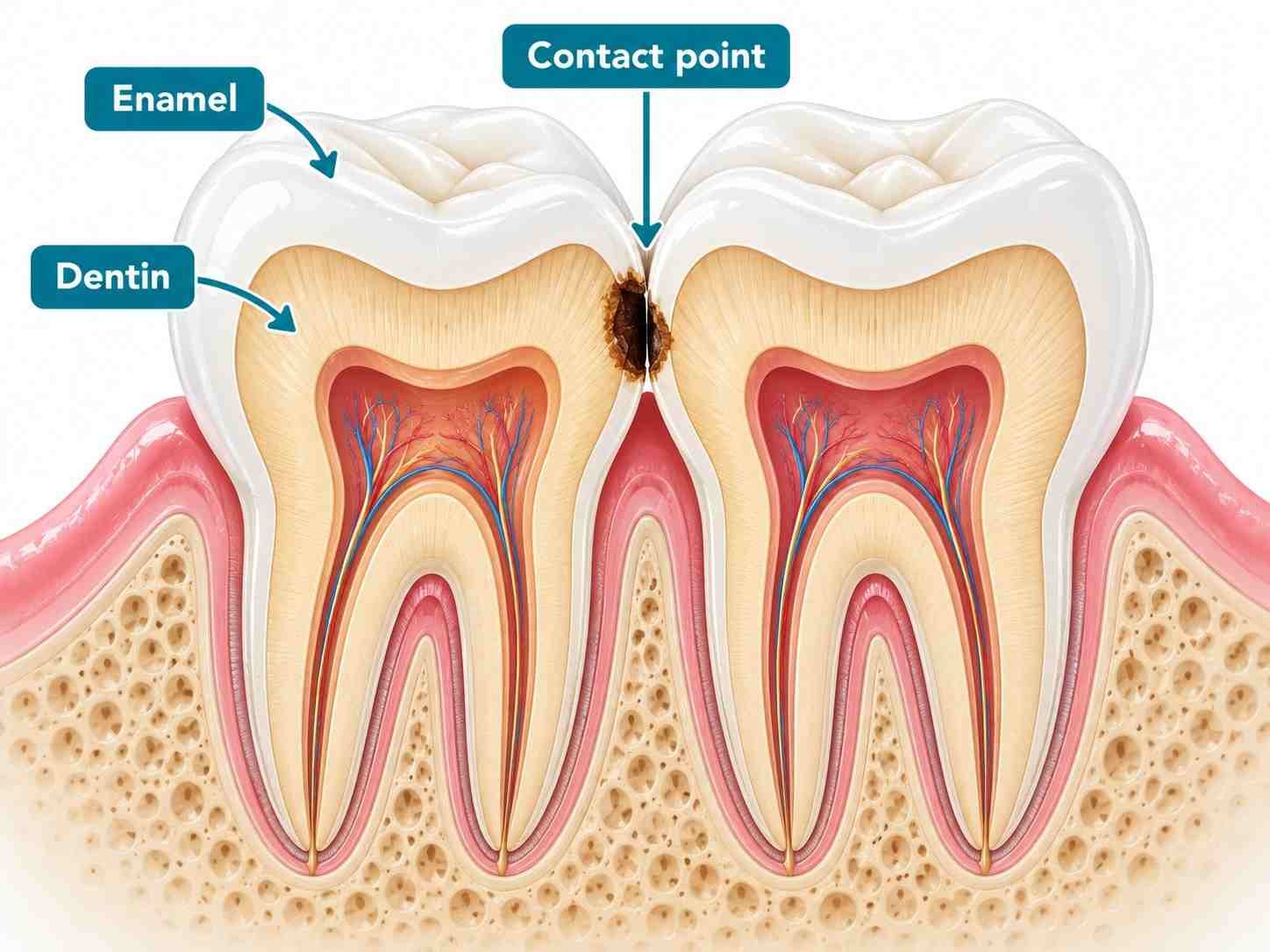
In the earliest stage, a cavity between teeth usually isn’t visible at all — this is exactly why dentists rely on X-rays rather than a visual exam alone. As decay progresses, some signs may become noticeable:
| Stage | What You Might Notice |
|---|---|
| Early (enamel only) | No visible sign, no pain; often shows only on a dental X-ray as a small dark triangle |
| Moderate (into dentin) | Mild sensitivity to sweets, cold, or pressure; occasional food catching between the teeth |
| Advanced | Visible dark spot near the gumline when floss is used, a rough edge felt by the tongue, or a small chip |
| Severe (near the nerve) | Noticeable toothache, sensitivity to hot and cold, swelling, or pain when biting down |
Because early interproximal decay hides so well, a cavity between teeth x-ray (called a bitewing X-ray) is the standard way dentists actually catch it — usually months or even years before a person would feel or see anything.
Are Cavities Between Teeth Common?
Yes. Interproximal decay is one of the most frequently diagnosed forms of tooth decay, largely because flossing is the most skipped part of most people’s oral care routine. Dentists routinely find these cavities in patients who brush twice a day but rarely floss, which is a strong reminder that brushing alone doesn’t fully protect the contact points between teeth.
How Are Cavities Between Teeth Diagnosed?
A dentist typically identifies a cavity between teeth using a combination of:
- Bitewing X-rays: These show the contact points between upper and lower back teeth and reveal decay long before it’s visible or symptomatic.
- A dental explorer or probe: Used to feel for soft spots or rough texture along the edge of the tooth.
- Floss threading: Dental floss that consistently frays or catches in one spot can be a clue.
- Patient-reported sensitivity: Sensitivity to sweets or temperature in one specific area often prompts a closer look.
Cavities Between Teeth: Treatment Options
Treatment depends almost entirely on how far the decay has progressed. Here’s how dentists typically approach cavities between teeth treatment by stage:
| Severity | Typical Treatment | What It Involves |
|---|---|---|
| Very early / white spot | Fluoride treatment or remineralizing agents | No drilling; strengthens enamel to potentially reverse the earliest stage |
| Small cavity between teeth | Tooth-colored composite filling | Decay removed, tooth reshaped with a bonded resin filling |
| Larger cavity | Inlay or onlay | Custom-made restoration bonded into the tooth for more structural support than a filling |
| Deep decay near the nerve | Root canal treatment, then a crown | Infected pulp is removed and the tooth is capped to restore strength |
For most patients who catch the problem at a routine checkup, the answer to “are cavities between teeth hard to fix” is reassuring: a small to moderate cavity is a straightforward, single-visit filling.
How Do Dentists Fix Cavities Between Teeth?
Here’s what actually happens during the appointment when a dentist fills a cavity between teeth:
-
Numbing the Area
A local anesthetic is applied so the tooth and surrounding gum are numb before any drilling begins.
-
Removing the Decayed Tissue
The dentist uses a small drill or laser to remove the softened, decayed portion of the tooth, working carefully through the tight contact point.
-
Shaping the Cavity and Placing a Matrix Band
A thin metal or plastic strip (a matrix band) is wrapped around the tooth to rebuild the missing wall, since the decay often removes part of the side facing the neighboring tooth.
-
Filling the Space
This is the step most people mean when they ask how cavities between teeth are filled: a tooth-colored composite resin is layered into the prepared space and hardened with a curing light, rebuilding the tooth’s original shape and contact point.
-
Shaping, Polishing, and Checking the Bite
The dentist trims and polishes the new filling, checks that the bite feels even, and confirms floss can pass smoothly between the teeth again.
How long does it take? A single cavity between teeth is usually filled in 20–40 minutes, and most people can eat normally again within a couple of hours once the numbness wears off.
Small Cavities Between Teeth: Can They Be Reversed?
Not every early lesion needs a filling. If a cavity between teeth is caught at the “white spot” stage — before it has actually broken through into a hole — the tooth may be able to remineralize with the help of fluoride varnish, fluoride toothpaste, and improved flossing. Once decay has created an actual cavity (a hole with softened dentin underneath), remineralization alone is no longer enough, and a filling is needed to stop it from spreading.
How to Prevent Cavities Between Teeth
Because these cavities form in a spot brushing can’t reach, prevention depends heavily on interdental cleaning. A few habits make the biggest difference:
- Floss once a day, every day — technique matters more than speed; gently curve the floss around each tooth rather than just snapping it up and down.
- Try interdental brushes or a water flosser if regular floss is difficult to manage, especially around braces or tight contacts.
- Use a fluoride toothpaste and consider a fluoride mouth rinse if your dentist recommends one.
- Cut back on frequent sugary or starchy snacking — it’s the frequency of sugar exposure, not just the amount, that drives decay.
- Chew sugar-free gum with xylitol after meals to help stimulate saliva flow.
- Keep up with six-month checkups and bitewing X-rays so decay is caught while it’s still small and easy to treat.
- Ask about dental sealants for children and teens, which can reduce decay risk on newly erupted molars.
When to see a dentist promptly: book an appointment if you notice a toothache, sensitivity to hot or cold in one specific tooth, food that keeps getting stuck in the same spot, or a rough edge you can feel with your tongue. Catching a cavity between teeth early almost always means a smaller, simpler treatment.
Frequently Asked Questions
How do dentists fix cavities between teeth?
The dentist numbs the area, removes the decayed portion with a drill, places a thin matrix band to rebuild the tooth’s side wall, fills the space with a tooth-colored composite resin, then shapes and polishes it so the bite feels natural.
Are cavities between teeth hard to fix?
Small to moderate cavities between teeth are generally straightforward and are usually completed in a single visit. Larger or deeper cavities may need an inlay, onlay, or in advanced cases a root canal and crown.
Can you see cavities between teeth without an X-ray?
Usually not in the early stages. Because the decay forms where two teeth touch, it’s typically hidden from view until it’s fairly advanced. A bitewing X-ray is the most reliable way to catch it early.
How long does it take to fill a cavity between teeth?
Most fillings for a cavity between teeth take about 20 to 40 minutes per tooth, depending on the size and location of the decay.
How do you stop a cavity between teeth from getting worse?
Daily flossing, fluoride toothpaste, cutting back on frequent sugar exposure, and regular dental checkups with X-rays all help stop decay from progressing — but once a true cavity has formed, a filling is needed to actually treat it.
Conclusion
Cavities between teeth are common precisely because the space where two teeth meet is one of the hardest areas to clean with a toothbrush alone. The good news is that they’re also one of the most predictable types of decay to manage: daily flossing and fluoride keep most of them from forming in the first place, regular bitewing X-rays catch the ones that do form while they’re still small, and a simple composite filling resolves the vast majority of cases in a single visit. The habits that prevent a cavity between teeth are the same ones that protect the rest of your smile — consistent interdental cleaning, a lower-sugar diet, and not skipping your dental checkups.